
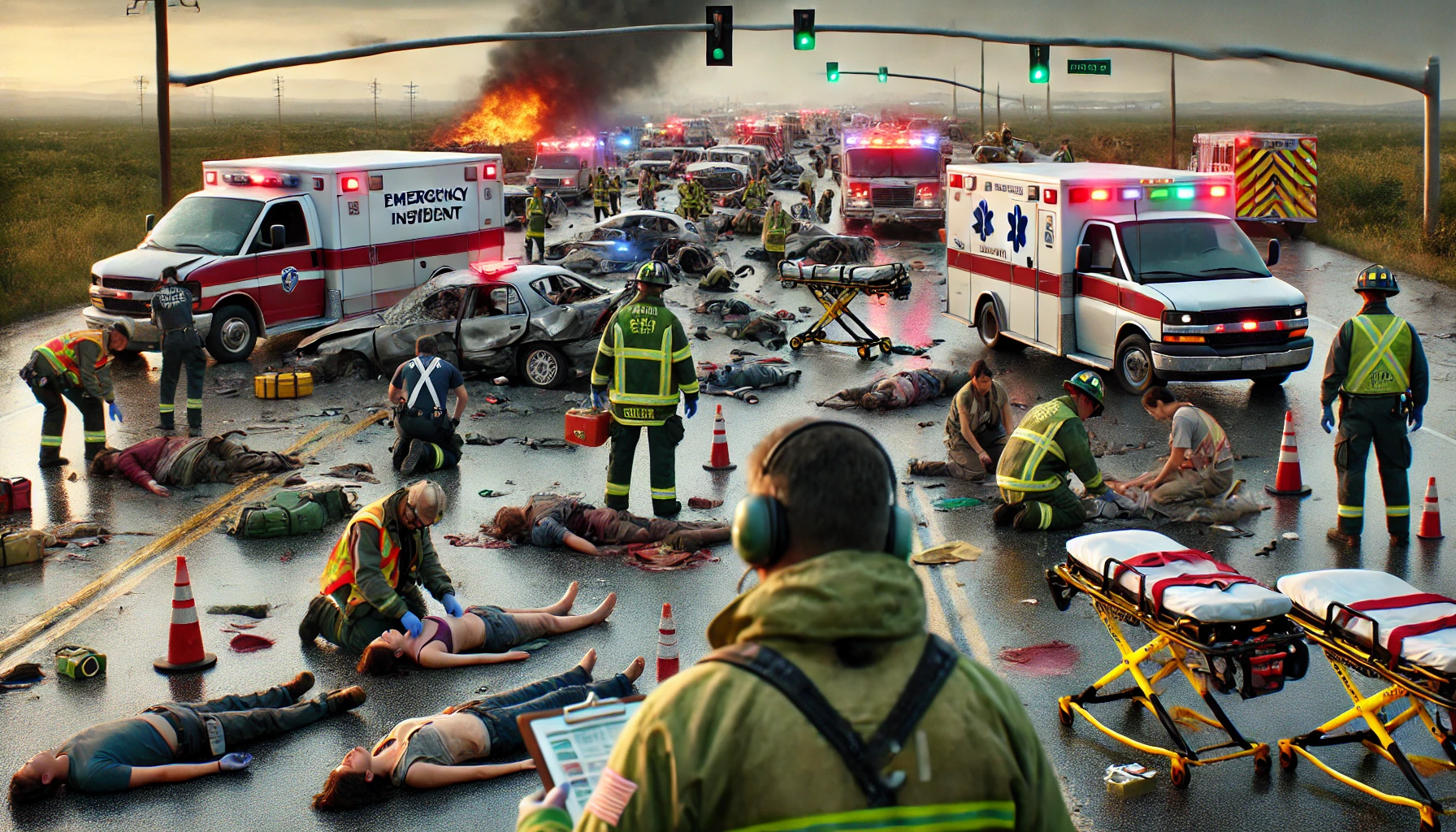
The first thing that comes to mind with MCI’s (Mass Casualty Incidents) is tabletop training. Time and time again, we’ve all sat around talking about triage, transport, Red, Yellow, Green, Staging—blah, blah, blah. But how relevant is it when it actually happens to you? Well… obviously, all of it is. But how do you tackle each chunk efficiently? Truth be told, it’s not as easy as tabletop training, purely because of the stress that inherently comes with the real thing. Let’s break down the initial on-scene aspects—some of the hardest to battle as an EMT or Paramedic.
Picture this: you show up with your partner, three cars involved, traffic backed up, people walking everywhere, and—worse—bodies and screaming. You know… Hell has officially broken loose. I’m sure that last statement made a few of your hairs rise, especially if you’ve been there before and know exactly what I’m talking about. Now, look out that windshield at the chaos in front of you. Take a deep breath. It’s time to make something happen. Unbuckle your seatbelt with just a few things in mind.
Typically, there are two of you on an ambulance—maybe a few more if you’re on an engine. We’ll play this talk with just two people because, for us rural folks, that’s about all we’ve got for a while. You’re the senior person. The paramedic. The experienced one. Guess what? You’re in charge. And here’s the kicker: you’re not providing any medicine. You don’t have the manpower for it. Your job right now is to coordinate the forces you have and request the forces you’ll need. That’s it. But it’s a lot to manage. Write it down. Stand back. Keep an open view of the accident scene, but DO NOT get tunnel vision or try to handle IC and patient care simultaneously.
This is, hands down, the most difficult thing to do as a paramedic. I hate watching someone I can’t help because I want to give my all to that person, that child, that screaming individual. But YOU are in charge. You stay back until additional people arrive to take over the IC position.
Next up: triage. This is best completed by a fully capable EMT. Triage has to be swift and efficient. I don’t care if you’re using SALT, START, RAMP, or whatever your agency or MPD (Medical Program Director) chooses—just make sure it’s easy and fast. I’ve been part of numerous MCI’s, and I can honestly say I’ve never once counted respirations to determine if someone’s red or yellow. Why? Because there’s too much stress, and thinking—let alone overthinking—is already hard enough. I use good ol’ experience and sick vs. not sick to make those decisions. Out of the above systems, I like SALT and RAMP, but I prefer RAMP (Rapid Assessment of Mentation and Pulse) for its extreme simplicity in the middle of mayhem.
Now, while the triage person is doing their job, we’re adding one more thing to their plate: life-saving interventions—but nothing more. If we go too far down the weeds, patients get neglected, and some will die. Keep it simple. Keep it fast. That’s what this is all about. I like to use the “MAR” portion of the MARCH acronym during the triage phase of an MCI:
•Massive Hemorrhage: Apply a tourniquet.
•Airway: Adjust an airway, maybe place an NPA.
•Respiratory: Needle decompression or chest seal for tension hemopneumothorax.
Wow… That’s a lot to pack into the first 2-20 minutes of an MCI. But it’s a solid start for field providers who don’t get to run these big events often. It’s a lot. It’s scary. It’s undeniably memorable and something you’ll never forget. But here’s the thing: it adds to your toolbox for when it happens again.
Keep it simple. Keep it fast. And don’t fall down the traumatic rabbit hole.

